Dental Implants in Reisterstown, MD

Most implant patients in Maryland end up seeing two offices: a surgeon to place the implant, and a dentist to make the tooth that goes on it. You repeat your history twice, pay two coordinators, and if something doesn’t fit right, each office points at the other.

We do both here. Dr. Alex Fishman completed a hospital-based residency at the University of Maryland School of Dentistry with training in oral surgery and implant placement, so the person who plans your case is the person who places it and the person who finishes it. The CBCT scanner is in our building. So is sedation.

One tooth or a full arch, your first visit costs nothing and ends with a written plan.

Placed and restored in one office
3D CBCT scan on site, same visit
Sedation available for surgical appointments
Free consultation, written plan, no obligation

What a Dental Implant Is

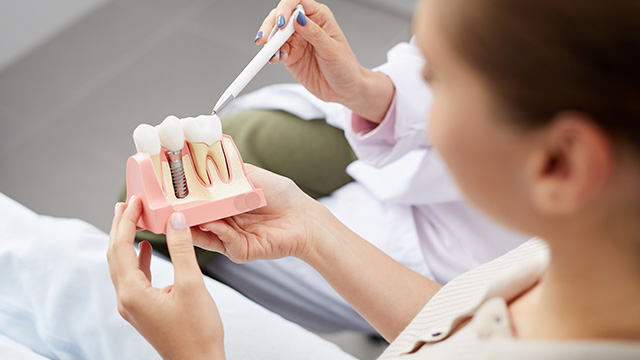
An implant is a titanium post that takes the place of a tooth root. It goes into the jawbone, and over the following months the bone grows against it and locks it in. That process is called osseointegration, and it’s the reason implants feel different from anything removable.

Once it’s stable, we attach the visible part: a crown for one tooth, a bridge for several, or a full-arch prosthesis for an entire jaw. Three pieces, then:

The implant

The titanium post in the bone. This is the part that lasts.

The abutment

The connector that links the post to the tooth above it.

The restoration

The crown, bridge, or full arch you actually see and chew with.

The distinction matters when you’re comparing prices and lifespans, because the post and the tooth on top age differently. More on that below.

Who Will Be Treating You

Alex Fishman, DDS

Alex Fishman, DDS

University of Maryland School of Dentistry. He stayed on for an Advanced General Practice Residency there, which is where he trained in oral surgery, implant placement, and laser dentistry. He grew up in Pikesville, and he bought this practice from Dr. Alvin Schuster, one of his mentors. He speaks Russian, which matters to a good number of our patients from Pikesville and Owings Mills.

John Longley, DDS

John Longley, DDS

University of Maryland Baltimore College of Dental Surgery. He started in dentistry as an Air Force dental assistant and has served as an Army Reserve officer for more than fifteen years, treating patients around the country. Patients tend to comment on the same thing: he explains why a procedure is being recommended, not just what it is.

Meet the doctors →

What Implants Can Replace

One missing tooth

A single implant and crown. The teeth on either side are left alone, which is the main advantage over a bridge: a bridge requires filing down two healthy neighbors to hold it.

Several missing teeth in a row

An implant-supported bridge, anchored on implants instead of on your remaining teeth.

A full upper or lower jaw

A fixed arch on four or six implants. It doesn’t come out. You brush it like teeth. All-on-4® → | All-on-6 →

A denture that won’t stay put

Implants can either anchor your existing style of denture so it snaps in, or replace it altogether with something fixed. Which one depends on your bone and your budget, and they are meaningfully different in cost. Dentures →

Are You a Candidate?

Most people who have lost teeth are. Bone loss is the usual worry, and it’s usually manageable. It’s a reason to plan carefully, not a disqualification. We’ve had patients arrive convinced they’d been ruled out elsewhere who turned out to have plenty to work with.

The scan settles it. Not a conversation, not a photo. Until we’ve seen the bone in three dimensions, nobody can honestly tell you yes or no.

Usually straightforward Needs planning first
One or more missing teethSignificant bone loss where the tooth is missing
You want something fixed rather than removableActive gum disease or infection
Healthy gums, or gum disease you’re willing to treat firstDiabetes that isn’t well controlled
Enough bone, or openness to graftingMedications affecting bone healing, including some osteoporosis drugs
Well-managed medical conditionsHeavy smoking

Nothing in the right-hand column is a no. Each one changes the sequence: treat the gum disease, graft the site, get the A1c down, time the procedure around a medication. Then place.

What the Process Involves

Every plan is different, but the shape is consistent.

  1. Consultation and scan (about an hour, free)

    Exam, CBCT scan, medical history. We look at bone volume and where the nerves and sinuses sit, then talk through the options, including the ones that aren’t implants. You leave with a written plan and a cost estimate. Nobody asks you to decide that day.

  2. Preparation, if needed

    Extractions, grafting, or gum treatment. This step is skipped more often than patients expect.

  3. Placement

    The implant goes in under local anesthetic, with sedation if you’d rather not be aware of it. A single implant usually takes about an hour.

  4. Healing (roughly three to six months)

    The bone integrates with the post. You’ll wear a temporary in the meantime for anything visible. We check on it along the way.

  5. Your restoration

    We scan or take an impression, the lab makes your crown or bridge, and we fit it, adjusting the bite until it feels like nothing.

  6. Maintenance

    Brush, clean underneath it, and come in for checkups. Implants don’t decay, but the gum and bone around them can get infected, and that is what causes late failures. It’s preventable and we’ll show you how.

Not sure whether implants are your best option? Come find out. The consultation is free, includes the 3D scan, and ends with a written plan you can take away and think about.

Book Your Consultation

Implants, Bridges, or Dentures

Implants aren’t automatically the right answer. They cost more up front and take longer. Here’s the honest comparison.

  Implant Bridge Denture
Best forOne tooth, several, or a full jawOne or more gaps with solid teeth either sideSeveral or all teeth missing
Effect on other teethNoneTwo healthy teeth are filed down to hold itNone
Bone underneathKeeps being stimulated, so it holdsBone under the gap still shrinksBone shrinks, which is why dentures need relining
Fixed or removableFixedFixedRemovable, unless implant-retained
LifespanThe post can last decades; the crown may need replacingOften 10–15 yearsRelined or remade periodically
Time to finishLongest, because of healingA few weeksShortest
Up-front costHighestModerateLowest

If you need something now and cost is the deciding factor, a denture is not a failure. It’s the right call for plenty of people, and it can be upgraded later.

Cost and Insurance

A single implant and a full-arch restoration that requires extractions and bone grafting are very different treatments with different costs. Your personalized estimate is provided after your consultation.

Instead, we offer a free consultation, where we can better understand your needs, discuss your treatment options, and provide you with accurate pricing.

What we can tell you now: we take all major insurance plans. Most cover part of implant treatment rather than the whole thing, and the annual maximum is usually the real limit. Coverage is often better on the pieces around the implant (the exam, the imaging, an extraction, sometimes the crown) than on the post itself. We check your benefits before you commit to anything.

For patients without coverage, we have an in-house membership plan through Kleer, and financing through Sunbit.

Does It Hurt?

Placement itself, generally no. The area is numb, and most patients say afterwards that it was easier than the extraction that preceded it. You’ll feel pressure. You shouldn’t feel pain, and if you do, we stop and add more anesthetic. Sedation is available if the idea of the appointment bothers you more than the appointment would.

Afterwards, expect soreness and swelling for two or three days, worst on day two. Most people manage on over-the-counter painkillers and are back at work the next day. Full-arch surgery is a bigger recovery than a single implant, so plan on taking a few days.

You’ll leave with written aftercare instructions and a number to call.

Serving Reisterstown and Nearby

We’re at 11813 Reisterstown Road, on MD-140, with parking on site. Patients come to us from Owings Mills, Pikesville, Randallstown, Glyndon, Garrison, Finksburg, and around Baltimore County.

Because implant treatment runs over several months, we try to group appointments so you’re not driving out here for five minutes of chair time.

Brilliant Smiles of Maryland
11813 Reisterstown Road, Reisterstown, MD 21136
(410) 833-8380

Monday, Wednesday, Thursday: 8:00am – 5:00pm
Tuesday: 8:00am – 7:00pm
Friday: 9:00am – 4:00pm

Frequently Asked Questions

How long does the whole thing take, start to finish?

+

For a single implant with no complications, usually four to six months from placement to final crown. Most of that is healing, not appointments. You’ll be in the chair maybe four or five times. Grafting adds a few months.

How long does an implant last?

+

The post itself often lasts decades; studies following implants out to 10 and 20 years show high survival rates. The crown on top is the part that wears, and it may need replacing once or twice over a lifetime, like any other restoration. Nobody can honestly promise you “permanent.”

What are they made of?

+

Medical-grade titanium, in use in dentistry since the 1960s. Some systems use zirconia.

Will insurance cover it?

+

Partly, usually. See the cost section above. We check your specific benefits at the consultation.

Why would I need a bone graft?

+

Bone shrinks once a tooth is gone, fastest in the first year. If there isn’t enough left to hold an implant securely, we rebuild the site first. The CBCT scan tells us before we start, not during surgery.

How do I clean one?

+

Like a tooth, plus attention to the gumline. Brush twice daily and clean between and underneath. For full-arch work you’ll need a water flosser or interdental brushes. We’ll show you on your own restoration before you leave.

I smoke, or I’m diabetic. Am I out?

+

No, but both affect healing and both raise the risk of the implant failing, and you deserve to know that before you spend the money rather than after. Well-controlled diabetes is generally fine. Smoking is the bigger factor, and cutting back around the surgery genuinely helps.

Can you place an implant the same day you pull the tooth?

+

Sometimes, if the socket is clean and there’s enough bone. It saves months when it works. The scan and the condition of the site decide it.

Start With the Scan

You don’t have to commit to anything to find out where you stand. The consultation is free, it includes the 3D scan, and you leave with a written plan and a number.

Brilliant Smiles of Maryland
11813 Reisterstown Road, Reisterstown, MD 21136
(410) 833-8380

Book Your Consultation